Archistory
HomeArchiveTime
Search
中文EN日本語

Archive

ArchitectsBuildingsTime

Periods

Classical EraMedievalRenaissanceBaroqueNeoclassicalIndustrial Revolution

Styles

Classical ArchitectureRenaissance ArchitecturePalladianismBaroque ArchitectureEnglish BaroqueMannerism

Search

Search architects or buildings...

Archistory © 2026
Archistory

Home/Architects/Lina Bo Bardi

Lina Bo Bardi

Portrait of Lina Bo Bardi

Portrait of Lina Bo Bardi

Unknown · CC BY-SA 4.0 · Source

Italian-born Brazilian modernist architect who reshaped Brazilian architectural identity through raw concrete, adaptive reuse, and deeply held social-democratic convictions.

Life span1914 – 1992Nationality / RegionBrazil
Portrait of Lina Bo Bardi

Portrait of Lina Bo Bardi

Unknown · CC BY-SA 4.0 · Source

Ideas

01

Architecture as social action: Design is not for aesthetic play but for serving disadvantaged populations and public life.

02

Rough poetry (Poor Architecture): Using cheap, local, raw materials, transforming poverty into strength rather than limitation.

03

Adaptive reuse: Respecting historical structures, converting old factories and buildings into new cultural containers.

04

Equality of people and things: In architectural space all elements — people, artworks, furniture, materials — possess equal dignity.

05

Southern translation of modernism: Deeply fusing European modernist principles with Brazil’s tropical reality, artisanal traditions, and material conditions.

Architect dossier

03

01 / 03

From Rome to São Paulo: A Woman Architect’s Revolution in the Southern Hemisphere

Lina Bo Bardi (1914–1992) is one of the most legendary figures in architectural history. She graduated from the University of Rome’s architecture program in 1939, during the dark years of Fascist Italy. After the war, together with her husband, art critic Pietro Maria Bardi, she emigrated to Brazil in 1946 — a migration she described as “from the ruins of the Old World to the infinite possibilities of the New.” In Brazil she found what Europe could not offer: a land where modern architecture and social relations could be rebuilt from the ground up.

The São Paulo Museum of Art (MASP, 1968) is her most iconic work. The project’s most radical feature was not the architectural design per se but her curatorial philosophy and display method: she invented the glass easel display system, where paintings are hung on transparent glass panels suspended in space, breaking the traditional wall-hung model. Visitors walk among the paintings and can see the back, sides, and front of each work from any angle — a thoroughly democratized viewing experience that refuses to impose any single vantage point. The building itself is equally radical: a pair of red, enormous concrete beams spanning 74 meters suspends the building volume in the air, freeing the ground-level public plaza beneath.

SESC Pompéia (1977–1986) further deepened her social architecture ideals. This community cultural center, adapted from a former oil drum factory, retains the raw, unfinished concrete structure rather than painting it over — cracks, stains, and surfaces sculpted by time are preserved as part of the building’s story. She introduced a winding concrete “river” into the space, connecting swimming pools, theaters, restaurants, and workshops, creating not a consumption space but a “third place” for civic gathering. This building remains one of São Paulo’s most vibrant civic centers today, where thousands of people from different social strata converge every week.

02 / 03

The Poetics of Roughness: Lina Bo Bardi’s Material Politics

If one word could summarize Bo Bardi’s material aesthetic, it would be “roughness” — but this is not the cold, monumental roughness of Western Brutalism; rather, it is a warm, tactile, almost artisanal roughness. She deeply loved concrete in its raw state: unpolished surfaces, visible formwork marks, the imperfect traces of hand plastering. For her these were not engineering defects but records of time, labor, and memory. At SESC Pompéia, she even insisted on preserving the graffiti left by workers on the old factory walls.

Her material stance carries explicit political implications. In Brazil — a society of enormous wealth disparity — choosing rough concrete over polished marble is not an aesthetic preference but a political statement: architecture should serve the majority in society, not please the elite. She once said: “True luxury is not gold and marble, but space and sunlight.” This explains why her buildings are visually so austere yet spatially so generous: ample public space, abundant natural light, free-flowing circulation — these are luxuries accessible to all.

Her furniture design embodies the same philosophy. The leather hammock chair, rough-wood long tables, and folding chairs she designed for SESC Pompéia use materials that are raw and direct, yet the proportions and ergonomics are precisely calibrated. These are not refined luxury goods but carriers of everyday ritual — inviting you to sit, converse, read, or simply gaze at the cityscape beyond the window. In Bo Bardi’s world, a rough surface is not the terminus of material but the starting point of an ongoing dialogue between people and things.

03 / 03

Belated Canonization: From Overlooked to Central in Architectural History

During her lifetime, Bo Bardi’s work was largely overlooked by the international architectural community. The reasons are complex: geographical marginality (Brazil lies at the edge of mainstream attention), gender bias (in a male-dominated architectural world she never received the same attention as her male peers), and the unclassifiability of her work itself — neither pure modernism nor postmodernism, neither European nor indigenously Latin American, but a unique synthesis.

When she died in 1992, she was still relatively unknown. Yet in the 21st century a quiet revolution occurred: a new generation of architectural historians and curators began to rediscover her work. The comprehensive restoration of MASP in 2012, a major solo exhibition at the 2014 Venice Architecture Biennale, and the publication of the authoritative monograph in 2018 elevated her status from “forgotten modernist pioneer” to “one of the 20th century’s most original architectural thinkers.” Her place among women architects is especially significant: before Zaha Hadid won the Pritzker Prize in 2004, Bo Bardi was one of the few women of the 20th century to leave an indelible mark on architectural history.

Her contemporary relevance goes beyond identity politics. In an era increasingly concerned with sustainability, community engagement, and adaptive reuse, Bo Bardi’s ideas and practices from the 1960s and 70s look prophetic. Her renovation philosophy of “keeping things raw, intervening minimally” — far ahead of today’s adaptive-reuse trends — and her conception of architecture as social infrastructure resonate deeply with contemporary debates about architects’ social responsibility and approaches to urban regeneration. She proved that an architect does not need a grand budget and iconic forms to make a profound impact; sometimes the opposite is needed — a compassionate eye focused on everyday life.

Sections

  1. 01From Rome to São Paulo: A Woman Architect’s Revolution in the Southern Hemisphere
  2. 02The Poetics of Roughness: Lina Bo Bardi’s Material Politics
  3. 03Belated Canonization: From Overlooked to Central in Architectural History

Reading the works

SESC Pompéia

SESC Pompéia

A civic cultural center adapted from a former oil drum factory, the warm embrace of rough concrete, the highest expression of an architect’s social care.

SESC Pompéia→
São Paulo Museum of Art building

São Paulo Museum of Art building

A suspended glass-and-concrete box, floating easels subverting the viewing order of the museum, and a public plaza that belongs to the city.

São Paulo Museum of Art building→
Glass House

Glass House

1951

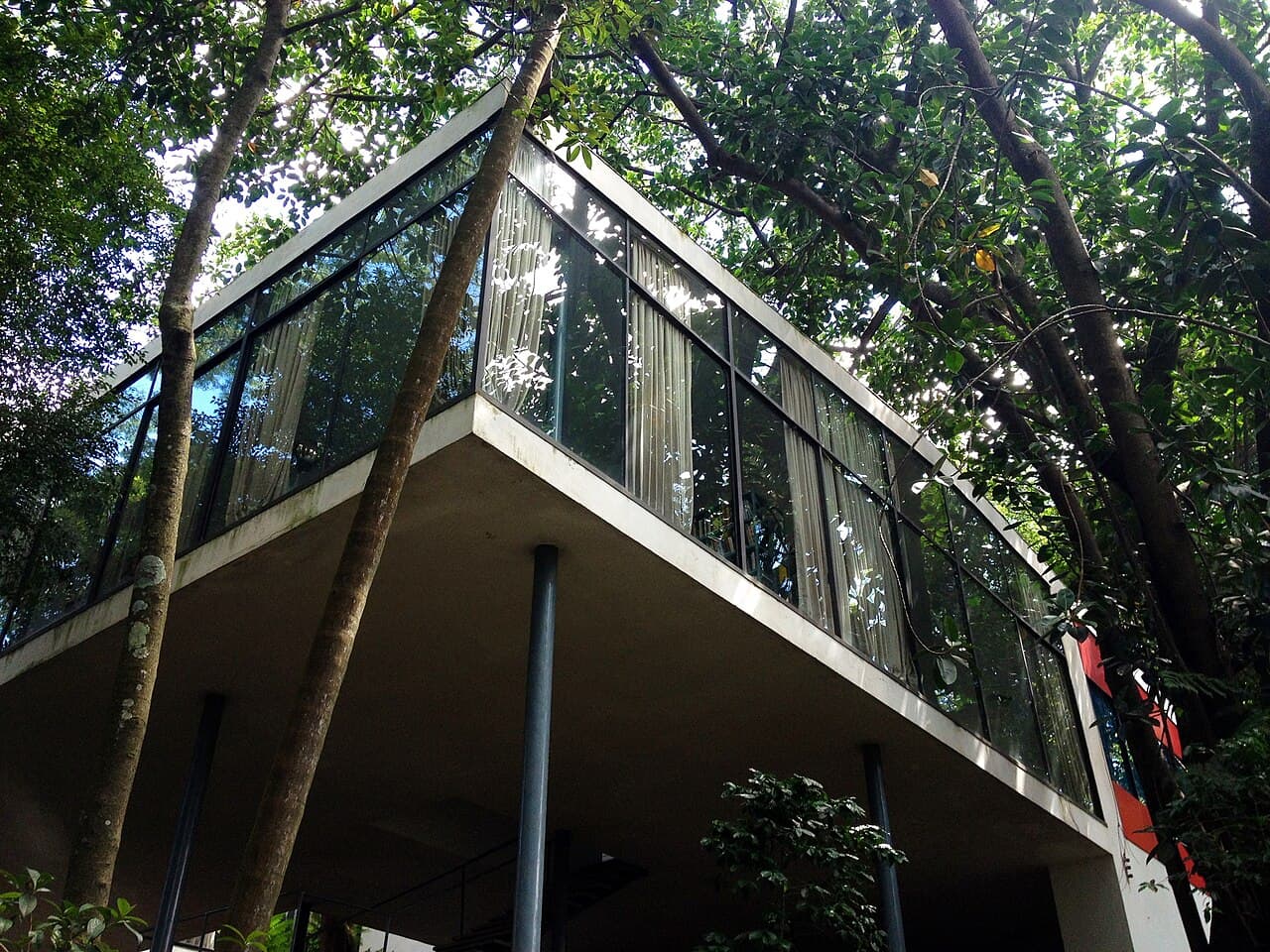
Bo Bardi’s own home, a steel-framed glass pavilion perched on a rainforest slope, a transparent dwelling overlooking the jungle.

Glass House→

Sources

  • Instituto Lina Bo e P. M. Bardi
  • Lina Bo Bardi — Wikipedia
  • Wikidata: Lina Bo Bardi

Works

10 buildings

1951Glass House
1964Casa do Chame-Chame
1990Coaty Restaurante
1993Teatro Oficina
?São Paulo Museum of Art building
?Valéria P. Cirell House
?Espirito Santo do Cerrado church
?SESC Pompéia
?Santa Maria dos Anjos Church
?Casa do Benin

All works

São Paulo Museum of Art building

São Paulo Museum of Art building

Coaty Restaurante

Coaty Restaurante

1990

Valéria P. Cirell House

Valéria P. Cirell House

Teatro Oficina

Teatro Oficina

1993

Espirito Santo do Cerrado church

Espirito Santo do Cerrado church

SESC Pompéia

SESC Pompéia

Santa Maria dos Anjos Church

Santa Maria dos Anjos Church

Casa do Benin

Casa do Benin

Glass House

Glass House

1951

Casa do Chame-Chame

Casa do Chame-Chame

1964