01 / 03
The Bauhaus: A school that changed the world
In 1919, Gropius merged the Grand-Ducal Saxon Academy of Fine Art and the School of Arts and Crafts in Weimar into the "Staatliches Bauhaus." The decision was itself a manifesto: art is not an elevated activity above craft but creative labor continuous with handwork and industrial production. He wrote in the Bauhaus Manifesto: "Architects, sculptors, painters — we must all return to craftsmanship."
The Bauhaus curriculum began with the Vorkurs (preliminary course), taught by Itten, Moholy-Nagy, Albers, and others, after which students entered workshops — wood, metal, ceramics, mural painting, weaving, stage. Gropius's innovation: each workshop was co-led by a "Form Master" (artist) and a "Craft Master" (craftsman), ensuring students were trained in both material and conceptual dimensions.
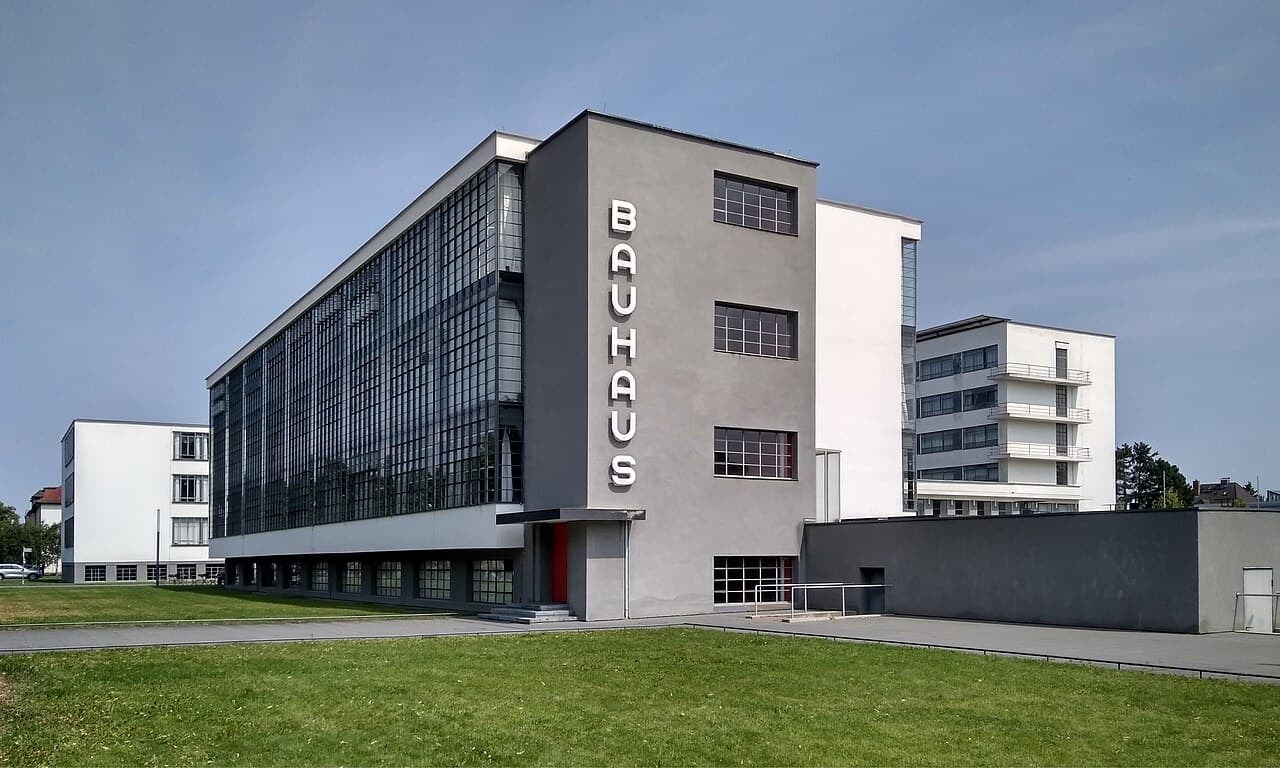
In 1925 the Bauhaus moved to Dessau, and Gropius's Bauhaus Building became a milestone — three functional blocks (workshop wing, classroom block, dormitory) linked by bridges, with a glass curtain wall used at scale as primary building skin for the first time, the steel frame legible. The building itself embodies Bauhaus pedagogy: transparent, rational, functionally clear, without superfluous ornament.